
HRM spends considerable amounts of money and staff resources in public consultation for urban planning and other projects but to what purpose? Listen to Sheldon MacLeod’s interview with Peggy Cameron about FHC’s letter to HRM’s Auditor General asking for a review of HRM Planning’s public consultative process as a Charter matter. The letter contains 10 case studies written by prominent HRM citizens who have engaged in public consultation but feel their voices have been ignored by the City (August 20, 2020)
FHC Requests HRM Auditor General Review Public Consultative Process as a Charter Matter
August, 2020-Letter to HRM Auditor General
Re- Review of HRM Planning’s public consultative process as a Charter matter
This letter (accompanied by 10 brief case studies) is to request that HRM Auditor General conduct a review of HRM Planning Department’s public engagement process and outcomes with respect to HRM planning and council votes. In writing to you we wish to note that we are aware of your July 2018 report to HRM Council on the operation of the Planning Department with respect to development agreements. We are prompted to write regarding a crucial aspect of the operations of that Department not addressed in the report, namely public participation.
The HRM Charter, Part VIII, s.208 states: “The purpose of this Part is to …(c) establish a consultative process to ensure the right of the public…to participate in the formulation of planning strategies…”
Continue reading
HRM Public Consultation Experience Submissions to HRM AG
FHC has requested in a letter to the HRM Auditor General that a Review of HRM Planning’s public consultative process as a Charter matter be conducted. Ten case studies written by individual citizens representing community groups who have engaged in HRM public consultation accompany the request. They are as follows:
1. Young Avenue District Heritage Conservation
Peggy Cunningham PhD
Chair, Young Avenue District Heritage Conservation
Professor, (Former Dean of Management) Dalhousie University
2. Halifax Home Owners Association/Peninsular South Residents Assn
Owen Carrigan PhD
Former President Saint Mary’s University
3. Halifax Military Heritage Preservation Society
Chris Marriott
Chair, Halifax Military Heritage Preservation Society
4. Development Options Halifax
Larry Haiven, PhD
Professor Emeritus, Department of Management, SMU
5. Peninsula Advisory Committee, Former Volunteer Member
Michael Bradfield, PhD
Professor (Retired), Department of Economics, Dalhousie
6. Centre Plan: Corridor Creep: Charles St
Howard Epstein, LLB
Former Halifax City Councillor, Former Nova Scotia MLA
7. Oak-Allan Street Bike Corridor–anonymous
8. WillowTreeGroup—from https://willowtreehalifax.wordpress.com
9. St Pat’s High School — Quinpool Common Group
10. Friends of Halifax Common – see www.halifaxcommon.ca, https://www.halifaxcommon.ca/wp-content/uploads/Attachment-new- APL-staff-report-required.pdf?189db0&189db0 etc.
Continue reading
In the News—parking garages, developments, Centre Plan

Maura Marche uses a hula hoop on the North Common part of the 245 acre Halifax Common given in perpetuity to “the inhabitants of the town of Halifax as Commons forever” in 1763 by King George III. (TIM KROCHAK-photo)
FHC Update: During COVID bubbling its been wonderful to see how many people are enjoying the Common for sitting, playing, eating, socializing or relaxing. A round up of recent media stories shows what Friends of Halifax Common has been busy doing to work with citizens to protect the Halifax Common. Legislative protection of the Halifax Common is critical, as is the need to re-commit to the goals of the 1994 Common Plan to keep, not give up, and re-capture its public open space.
- Our Chronicle Herald Op Ed asks Herald Op Ed: Why do HRM’s mayor and council hold the Common in such contempt?
-
Rick Howe News 95.7: Health Do$$ars to Build Parking Garages – Governments Going Backwards

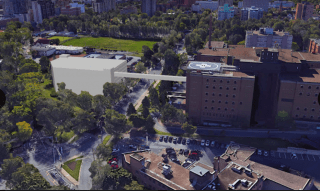
Proposed 512-stall parking garage at the Halifax Infirmary site with the pedway spanning Summer Street. A second 1000-stall parkade and steam plant will be at Summer/Bell. (rendering by Marcel Tarnogorski)
News 95.7 Rick Howe speaks with Peggy Cameron on “Why do HRM mayor and council hold the Common in contempt?”
Eliminating green space to build expensive new parking garages is a turn in the wrong direction. Over 50% of hospital staff are interested in other transportation options. So why aren’t governments working to improve transportation options and stop giving up health benefits of green space?
Herald Op Ed: Why do HRM’s mayor and council hold the Common in such contempt?
K’JIPUKTUK (Halifax) On June 23, the Halifax Common, Canada’s oldest and largest, turned 257. There is good news.

A pedestrian walks across the Halifax Common in early March. “Although HRM’s Centre Plan intends to add 15,000-30,000 new citizens to the Centre Plan area, it has not designated any new urban parks and it includes no green networks. This is intentional, not an oversight.” Photo: Ryan Taplin
The 1994 Halifax Common Masterplan goals committed to by the city continue to be front and fore in citizens’ present-day desires. This is reflected in findings of the public consultation for the new masterplan begun in 2017 — plan for the entire Halifax Common; keep it open with green, natural landscapes and water features; minimize development; limit imposing structures; create a sense of connection; include walking and cycling paths; rebalance uses — recreation, arts, events, growing food; ensure access, diversity, inclusion, safety, youth, family.
But the rest is bad.
Unfortunately, the draft Halifax Masterplan, last seen in June 2019, does not plan for the entire Common, but only the city-owned property. This continues governments’ well-established pattern of diminishing, degrading or selling off the public’s land. Immediately before the consultation, the city was silent on the sale of the CBC-TV lands and was secretive on its privatization of the Wanderers’ Grounds.
Presently, the COVID-19 pandemic has us reorganizing society and economy with new forms for work, school and leisure that are still evolving. That public open space is vital to mental and physical health is increasingly evident as people seek to escape small apartments, to exercise or to enjoy a connection to nature. And the need for space for safe social distancing to walk or bike has cities around the world investing millions to create permanent bike lanes and new parks.
But although HRM’s Centre Plan intends to add 15,000-30,000 new citizens to the Centre Plan area, it has not designated any new urban parks and it includes no green networks. This is intentional, not an oversight.
One positive outcome from COVID-19 worldwide is less traffic and parking demand and lower greenhouse gas emissions — nearly half because of transportation, primarily trucks and cars. The Halifax Common’s 240 acres is about 20 to 25 per cent parking lots. There is an obvious opportunity to re-naturalize, re-wild or landscape them to create new park space, and a cheap, efficient way to deal with major impacts from climate change (i.e., stormwater, flood management, heat waves, carbon sink) and pollution. New habitat, revitalization of dead zones and increased citizens’ care for and interest in nature are important side benefits.
But Mayor Mike Savage and council have no plans to change this usage. In fact, they recently approved plans for a new eight-storey parking garage by the Nova Scotia Museum of Natural History. That’s despite about 3,000 citizens petitioning against the garage and for protection of the Halifax Common.
Along with a second parking garage on the former CBC-TV site, a total of at least 1,500 cars will now congest one of the city’s most walked, biked, played-on areas at the confluence of Citadel High, the Nova Scotia Museum, Bengal Lancers, Wanderers’ Grounds, skate park, soccer field, Oval, children’s playground and a proposed new aquatic centre. These will now face a wall of parking garages, enjoy a soundscape of traffic and emergency vehicles and endure the health harms of toxic emissions.
But what of citizens’ desire to minimize development, limit imposing structures and keep the Common open?
Well, a minimum of 10 new highrises, between eight and 30- storeys, are in the works on or around the Common through development agreements. And in exchange for the hundreds of millions of dollars in development rights (i.e., profit) handed to developers, affordable housing unit numbers are going backwards.
Councillor Shawn Cleary’s motion for 25 storeys at the Willow Tree in exchange for 10 units for 15 years has now been cashed out for $1.8 million; Coun. Lindell Smith’s motion for 23 -storeys next door will net $180,000 and Coun. Waye Mason’s support for 16-, 22-, 26- and 30-storey towers will destroy about 100 affordable housing and small-scale commercial units that won’t be replaced.
Passing the Centre Plan formally increases height limits in Designated Growth Areas and Corridors. This further incentivizes the demolition of thousands of unique small-scale Halifax buildings and character streetscapes, such as those by the Halifax Common on Robie or along South Street.
Planning for demolition rather than deep energy retrofits or infill also harms the collective Common. Thirty-nine per cent of GHG emissions come from building and construction, adding to climate change. And citizens living, walking or cycling by traffic corridors are well understood to suffer detrimental health impacts (asthma, lung function, strokes, heart attacks, cancers) from associated air pollution and noise, such that experts suggest residences and parks be set back 150 metres (a block) from traffic corridors.
HRM recently reversed its decision to purchase diesel buses and now will go with an entirely electric fleet. It also recently reversed an earlier decision to purchase an armoured vehicle. It is presently looking into changing the zoning of 136 acres for sale to protect the Williams Lake Backlands area. And HRM just adopted its HalifACT 2050 climate change plan. Why does it continue to be so difficult for the mayor and council to protect the Halifax Common?
The Common is physically at the heart of the peninsula and thus of HRM. How can councillors continue to fail to listen to the public’s voice?
Peggy Cameron is co-chair, Friends of Halifax Common.
Please support local media!-https://www.thechronicleherald.ca/opinion/local-perspectives/peggy-cameron-why-do-hrms-mayor-and-council-hold-the-common-in-such-contempt-467838/
RFP for 8-storey parkade on North Side of Museum of Natural History Has a Nasty Surprise
KJIPUKTUK (Halifax) With no explanation, Department of Transportation’s 889 page RFP for the
Summer Street parking garage has a nasty one-sentence surprise buried deep inside the Sustainability Requirements section that specifically eliminates superior-to-conventional-ramp-parking alternative solutions.
The proposed 512-stall parkade north of the NS Museum of Natural History with the pedway over Summer Street. A second 1000-stall parkade will be at Summer/Bell.
Summer Street parking garage has a nasty one-sentence surprise buried deep inside the Sustainability Requirements section that specifically eliminates superior-to-conventional-ramp-parking alternative solutions.
“Automated parking facilities and systems capable of receiving, parking, and retrieving passenger vehicles automatically are not considered viable for this project application.” page 139, Sustainability Requirements, Section 01 35 63 Page 3, OTHER GREEN INITIATIVES paragraph 1.3.2
And yet an automated robotic valet parking system would be the most sustainable choice. For example:
- Halifax Infirmary Site Location: the garage would be ~40% smaller with the same number of stalls and would fit on the surface parking lot on Robie Street next to the Veterans Memorial building, a shorter distance to the hospital entrance.
- Green space: There would be no loss of public open space on the Nova Scotia Museum of Natural History where the 8-storey conventional parkade is slated to be constructed. Approximately 2,900 citizens petitioned municipal and provincial governments to not allow expansion of any component of the Halifax Infirmary re-development outside of the 22 acres it has assembled.
- Pedway: There would be no need for a pedway over Summer Street between a conventional parkade and the hospital entrance.
- Health and Safety Impacts: Exposure of users breathing the toxic mix of car exhaust gases and brake and tire dust would go from well over 100,000 hours a year, to ZERO. Greenhouse gas emissions by users driving within the conventional parking garage would go from ~38 tonnes of CO2 per year to essentially ZERO. Less interaction with other users means better social distancing. Provision of Accessible parking spaces would increase from 15 of 512 stalls to 100% Accessible. Robotic valet parkades eliminate potential criminal assaults (including rape), vandalism, thefts from their cars, as only maintenance staff can ever enter the parkade itself.
- Construction and Operational Cost: In many cases an automated robotic valet parking system is less expensive and quicker to build and is almost certainly less expensive to operate than a conventional ramp parkade of the same capacity.
Early in the process the Nova Scotia Lands Hospital Design team was made aware of and researched automated robotic valet parking systems and presented options based on the concepts to the Department of Transportation and Infrastructure Renewal (DTIR).
Who edited and released the RFP that outlaws the automated parking design paradigm?
Who benefits from eliminating the most sustainable option and cost effective choice from the bidding process?
What is the justification for not considering the most modern parking technologies for a building that is supposed to be the first part of a “State of the Art” $2,000,000,000 QEII Next Generation Project.
Will there also be a second-best choice for a conventional 1000 stall parking garage to be constructed on the former CBC TV lands?
Approximately 25% of the Halifax Common’s 240 acres is used for parking. The positive effects of green space on all aspects of health and the push by the city to densify population on the Peninsula mean remaining green and open Common land must be protected against more parking and further development. No traffic study has been conducted and no alternatives to the parking garages have been considered.
To date Nova Scotia Government has failed on its commitment to make public its fraud risk

report for the $2 billion P3 QEII redevelopment plan, the largest infrastructure project in the province’s history. A CCPA-NS report on the re-development raised concerns about transparency and accountability in the P3 decision making process and found that the private financing is 125% more than comparable public borrowing.
This rendering from Halifax Infirmary redevelopment website does not show the proposed 8-storey parking garage on the NS Museum land. An automated parking garage would fit on the surface parking lot next to the Veterans Memorial hospital on Robie near Jubilee.
https://kasian.com/news/kasian-continues-to-support-the-qeii-new-generation-as-the-planning-design-team/
A second 1000-stall parking garage will be built on the former CBC-TV site (lower-right) bringing a total of 1512 cars to the area. Bell Road will be widened.
report for the $2 billion P3 QEII redevelopment plan, the largest infrastructure project in the province’s history. A CCPA-NS report on the re-development raised concerns about transparency and accountability in the P3 decision making process and found that the private financing is 125% more than comparable public borrowing.
The Terms of Reference for the parkade RFP included the following;
Deliver a project centered on people and health, with healthcare rated
indoor environmental qualities. The parkade sustainable goals include:
1. Managing parking requirements efficiently
2. Increase energy efficiency and performance
3. Reduce environmental Impact
4. Encourage alternative mobility options
2. The consultant is expected to make design recommendations based upon the design’s ability to support and enhance:
- program delivery and operational approaches
- aesthetic considerations
- functional relationships
- code requirements
- green/sustainability
- healthy building considerations
- energy conservation
- SmartTrip Program / Halifax EPass
- Crime Prevention Through Environmental Design (CPTED) features.
Halifax council approves new hospital parking proposal for Summer Street
This rendering by community volunteer Marcel Tarnogorski shows the proposed 512-stallparkade at the Halifax Infirmary site, with the pedway spanning Summer Street. A 1000-stall parkade and steam plant will be at Summer/Bell.
CBC, Pam Berman, April 9, 2020
…” Friends of the Halifax Common, are still unhappy with the plans to build parking structures in the area.
“Neither the city nor the province have a strong sense of what is the real value of the Halifax Common,” said Peggy Cameron. “It was public, open space that was given to the citizens forever.”
Cameron points out when the city of Halifax ceded the land to the province in 1968 for the Museum of Natural History, there was no mention of using it for a parkade. The group is calling for the city and province to provide increased busing options for hospital staff to reduce the amount of parking needed.”
Continue reading
Council OKs revised parkade plan – Chronicle Herald
Chronicle Herald, Frank Campbell , April 10
This rendering by community volunteer Marcel Tarnogorski shows the proposed 512-stallparkade at the Halifax Infirmary site, with the pedway spanning Summer Street. A 1000-stall parkade and steam plant will be at Summer/Bell.
“…The Friends of the Common group doesn’t agree that it’s a win for the city or its citizens.
In a news release Wednesday, the group said it had 2,900 citizens sign a petition to the mayor and council objecting to any components of the Infirmary site going on the museum side of Summer Street and asked that council seek legislative protection.
“Approximately 25 per cent of the Halifax Common’s 240 acres is used for parking,” the group asserted. “The positive effects of green space on all aspects of health and the push by the city to densify population on the peninsula mean remaining green and open Common land must be protected against more parking and further development.” Continue reading
New Parking Garage Proposal is 8-storeys on north side of NS Museum
 FHC has written a letter to HRM Council asking that they refuse the Provincial Government’s latest proposal for an 8-storey, 512 stall parking garage on the north side of the Nova Scotia Museum Site. (An entrance would be on Bell Road and it would connect to the Halifax Infirmary via a pedway across Summer.) A second 1000-stall parking garage and a steam plant would be built on the former CBC-TV site. The proposal and staff report, are the only items for Council’s virtual meeting on Thursday April 9. There has been no public consultation.
The Friends of Halifax Common ask that Council adopt resolutions to:
- Remind the Province that in its unilateral original proposal it did not abide by the Memorandum of Understanding MOU (2008) between HRM and the Province to consult over any proposed new uses for Halifax Common land;
- Reaffirm that the 1968 conveyance of the land at “City Field” from the City of Halifax to the province was required for a Nova Scotia Museum and was “made available to the Province for such a purpose”, not a parking garage (see the deed and 1968 Halifax Council resolution here nsm 1968);
- State the intention of HRM not to facilitate the placement of a parking garage or pedway on any land adjacent to the Museum; and
- Affirm the preference of HRM that any expansion or reconfiguration of Halifax Infirmary buildings take place exclusively within the confines of the 21.5 acres of Halifax Common land now occupied by it (bounded by Robie St, Bell Road, Summer St, and Veterans Memorial Lane).
Welcome Spring Around the Common!

FHC’s 2014 photographic exhibition “Parking the Common” found 20-25% of the Common is parking, a private use of public space. Making the Common Halifax’s first car free zone would be an investment in our future. Imagine Central Park as you walk the 4km perimeter to welcome Spring! Cunard, North Park, Ahern, South Park, South, Robie.
Why not welcome Spring with a walk around the Common? The perimeter is ~4km and it takes ~1 hour to circumnavigate. Until now public directives telling us to stay at home to help flatten the COVID-19 curve have not banned being outside. That’s lucky, as while our society prioritizes health benefits associated with rigorous physical activity – sports, running, gym-workouts – having regular outdoor time has important physical and mental health benefits such as reducing anxiety, stress and negative emotions; improving memory, immunity, healing, focus, vision, longevity; and managing weight or growing food! See FHC bibliography greenspace
Remember to respect the 2m social distancing directive as many countries have shut parks Continue reading
Petition to Protect the Halifax Common

Proposed 7-storey parking garage next to the NS Museum of Natural History, Bengal Lancers and Wanderers Grounds. The steam / power plant will be on the north (right) side. (model by Marcel Tarnogorski)
Update: Congratulations, you made the difference! A sincere thank you to everyone who took the time to send an email, sign the petition and show support for the Halifax Common. On Tuesday Feb 25, Waye Mason tabled the petition at HRM Council. FHC is working to have the petition tabled at the Nova Scotia Legislature. An important goal is to have legislative protection of the Halifax Common; clearly, compromises behind closed doors aren’t working.
Update: On Feb 11 HRM Council “compromised” with the Province by agreeing that the parkade and steam plant may be built on a western portion of Summer Street. This will impact only item #2 in the petition. FHC is continuing to collect signatures to increase public – pressure as the Halifax Common is still not protected! Please sign our on-line petition to protect the Halifax Common —
https://bit.ly/2v0w9kn Details below: