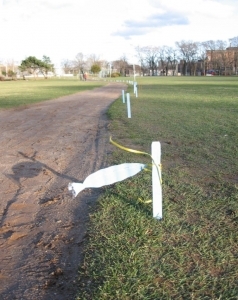
Friends of Halifax Common celebrated Earth Day 2011 by installing
100 blue stakes along the former pathway of Freshwater Brook. Approximately 30 willow tree switches were planted alongside the blue stakes which were decorated with fish – as a reference to the former waterway. The original Halifax Common included the lands which drained into this stream that is now buried, channeled or diverted underground. The watershed was a marshy, wooded area with the stream starting above the North Common and running through the Central Common (the small Egg pond there is now part of the skate park), the Public Garden (Griffin Pond) all the way to the Halifax Harbour below Inglis Street. In former times ships would collect fresh water from this brook at the Harbour outfall.
For an illustration of the Freshwater Brook’s path from “Representing Halifax: Exploring the Potential of the City through Mapping” by Matt Neville.
see: https://spacingatlantic.ca/2010/01/28/representing-halifax-exploring-the-potential-of-the-city-through-mapping/
Media Release – $6M for Oval is Ad Hoc Planning
HRM Staff Support of $6 Million Centralized Oval is Ad Hoc Planning
(Halifax) The HRM staff report on the Canada Games Oval recommending a single centralized skating facility on the Halifax Common is ad hoc planning, according to Friends of Halifax Common (FHC). The group questions the oval’s placement, the planning process and the price tag.
“Friends of the Halifax Common definitely support an outdoor rink, but we believe other locations such as on the Central Common or the Wanderer’s Grounds, or several outdoor skating rinks in local communities throughout HRM would be just as popular as the single giant oval on the North Common” said Peggy Cameron, Co-chair of the Friends of the Halifax Common.
The North Common is less than one-third of the remaining public open space on the Halifax Common, which extends from Cunard St. to South St., bounded by Robie, North Park and South Park Streets. All decisions made by staff and council since the Halifax Common Plan was adopted in 1994 have been inconsistent with it.
HRM staff’s January 2010 North Common Master Plan included ‘improvements’ to the North Common with the major portion of the $2.7 million budget going towards permanent infrastructure for the private, expensive mega-concerts. Reference to these already made expenditures have dropped out of site. Continue reading
The 1994 Halifax Common Plan

In 1994, after public uproar over paving part of the Common for the Grand Prix road races, Halifax City Council adopted the Halifax Common Plan after a successful and meaningful public consultation. It promised…
Section 2.1:The amount of public open space in the Halifax Common will not be decreased.
Section 3.1:The amount of land owned by the City of Halifax will not be decreased.
Section 3.2: The city will seek to increase the amount of land under city ownership through recapture of lands.

The original Common boundaries were outlined in red on this map from 1898. Here we show it in green.
1993CommonPlanPublicConsult
2006 HRM call for plan review of 1994 Plan
1994 Halifax Common Plan on HRM website
2006 HRM call for staff update
The Tragedy of the Common – Coast Magazine
The Tragedy of the Common: If the Common is so common, why can’t common people decide how to use it?
The Coast Magazine, Opinion – Sustainable City, by Chris Benjamin
Tragedy-of-the-Common_THECOAST – PDF
from: https://www.thecoast.ca/halifax/tragedy-of-the common/Content?oid=1503404
“Picture a pasture open to all.” So wrote Garrett Hardin in his 1968 Science article, “The Tragedy of the Commons.” His thesis was that a shared natural resource, in self-interested human hands, could only be destroyed. It was a thought-provoking article that is still invoked to advocate and justify private ownership.
The history of our own Halifax Common at times veers toward destruction, but it has survived shared ownership by the people, either because or in spite of municipal government intervention. The Common was once a shared Hardinesque pasture. It has also been a campground, a dump and a race track twice—once for horses and once for cars. It used to be much bigger, but pavement, steel and glass ate the grass. Continue reading
Article The Right to the Common – by Katie McKay
from: SPACING ATLANTIC
HALIFAX – Last Wednesday January 20th, HRM staff presented the plan “Improvements to the North Common” [PDF] to a full house, where there were more people in attendance than there were chairs. The presentation of the plan lasted an hour, and although only 30 minutes was set aside for input from the public, the question period ended up continuing for over an hour and a half, until only a handful of people were left in the room.
In this new century, we are facing a different kind of threat to public space— not one of disuse, but of patterns of design and management that exclude some people and reduce social and cultural diversity… to read more download pdf
Drawing Green Parallels – Chronicle Herald
Drawing Green Parallels
Commons supporters, climate change activists join forces to highlight need to protect nature
By MICHAEL LIGHTSTONE Staff Reporter, The Chronicle Herald
’Our vanishing Halifax Common(s) is a metaphor for the disappearance of our global Common, most urgently our atmosphere and climate’ SHEILAGH HUNT – Friends of the Halifax Common
Remnants of the original Halifax Commons are representative of the “disappearance of our global Common,” park lovers and climate change fighters say.
An event promoting today’s International Day of Climate Action and bemoaning the vanishing Halifax Commons was held Friday afternoon. Less than one-third of the Halifax Common’s original 95.1 hectares, granted in 1763 by King George III, is public open space, say Friends of the Halifax Common.
Members and supporters drew a line around the entire perimeter of the original Commons. Volunteers were supplied with chalk at various meeting points around the site.
“Our vanishing Halifax Common(s) is a metaphor for the disappearance of our global Common, most urgently our atmosphere and climate,”” said Friends member Sheila Hunt. Continue reading
Take a Chalk Around the Common-International Day of Climate Action 350.org
Halifax- In support of 350.org, International Day of Climate Action, Friends of Halifax Common
are inviting the public to volunteer to help them in drawing a chalk line around the entire perimeter of the original Common. Join them on Friday October 23rd from 12-2 p.m.
Less than 1/3 of the Halifax Common’s original 235 acres granted in 1763 by King George III is public open space.
“Our vanishing Halifax Common is a metaphor for the disappearance of our global Common, most urgently our atmosphere & climate” said Sheila Hunt of the Friends. “Our air, water, and land – the common heritage of all people – are being degraded. How we choose to deal with the finite natural resources of our planet has lasting repercussions for future generations.”
Continue reading
The Coast, Bruce Wark Editorial – Looking for Common Sense
E D I TO R I A L by Bruce Wark
Under the deal, the province gets the former Birks site on Barrington to build more office space plus the Queen Elizabeth High site at Robie and Bell for expansion of the QE II Infirmary. In return, the city gets the block on Queen between Spring Garden and Morris for a central library, officespace, shops and housing.
Halifax Metro News – Hospital space trumps green space in Common decision
By Lindsay Jones
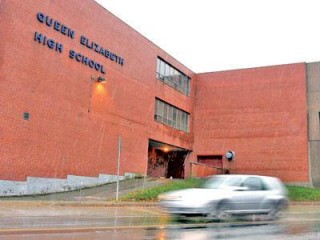
Regional council approved giving up the rest of the Queen Elizabeth High School land to become part of a hospital expansion yesterday.
The city is exchanging the former Halifax Common land, as well as several other parcels, with the province to help pay for land at the corner of Queen Street and Spring Garden Road. That’s the site where the city wants to build a new Central Library. Continue reading
Media Release – Common for Sale?
Is the Halifax Common for Sale?
HRM Council is going to sell the Queen Elizabeth High School site, Halifax Common land. This is to facilitate Flagship Developments on Spring Garden Road & Queen (the new public library) and the Grand Parade & Province House.
The Halifax Common Plan is very specific about the amount of city-owned land in the Halifax Common not being decreased (3.1). The Plan recommends preserving public open space for a variety of outdoor recreation and leisure activities or other suitable public uses.
Continue reading
Chronicle Herald Op Ed – Protecting Halifax’s Common Ground

Public money spent by HRM for private, expensive Concerts on the Common would be better spent on protecting the Common for everyone.
Recently, Friends of Halifax Common were informed HRM will begin electrical repairs to the Centennial Fountain on the North Common. This was conveyed to us as a “good news” story. Indeed there hasn’t been much good news about the Common for a long time.
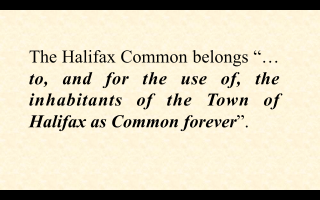
The Halifax Common, Canada’s oldest urban park, was created in 1763 when King George III granted 240 acres “for the use of the inhabitants of the Town of Halifax forever.” Originally extending between Cunard and South Streets, bounded by Robie on the west Continue reading
Friends of Halifax Common Challenge Sale of Common Land – Media Release
Friends of Halifax Common (FHC) are calling on the provincial government to stop the sale of 5.5 acres of Halifax Common land at the former Queen Elizabeth High School (QEHS). The QEHS land is included in a land swap between HRM and the province. FHC says this a bad deal. HRM will lose public open green space, pay $1.9 million for the land swap but will acquire half as much as land as the province.
Continue reading