Tag Archives: 29 storey Armoyen

Please, Write to Stop this Shady Dealing!

Tell the Mayor and Council to Stop this Shady Dealing! Download the ‘poster’ here: Stop This Shady Dealing

HRM Council moves one step closer to approving a 20 or 29- storey mega-lithic money-maker tower for APL (George Armoyan) at Robie & Quinpool on March 21st. That’s against what 99% of citizens who spoke at public meetings or wrote letters want.

But letters don’t get carried forward so if you didn’t write in March, Councillors won’t know you are against this project!  You still have time to write to tell them to not continue the approval process. Ask them to focus on the Centre Plan and the Halifax Common Plan, not individual developers.

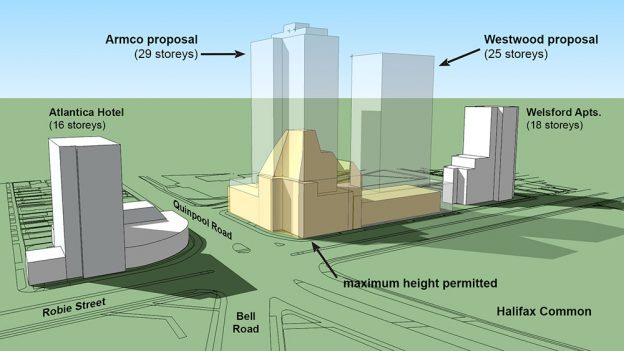
FYI – 20 storeys isn’t a compromise-its twice as high as what’s allowed, as what’s there & two floors higher than the convention centre.

This is the thin edge of the wedge as other developers are chomping at the heels of staff and council to get break rules for their proposed projects for  13-, 14-, 16-, 20-, 25-, 26- and 30-storeys on or next to Continue reading
Write to Stop 20+ or 29-storeys at Quinpool/Robie

Armoyan’s proposal comes before Council on Tuesday, March 21. As a next step, a public-hearing date will be scheduled. Please write to say: re Case 18966: Do not approve APL’s 20 or 29-storey tower at Robie & Quinpool at this time. Wait for the Centre Plan.

Dear Mayor and Council:
Please say “No!” to the proposed 20- or 29-storey Armoyan tower at Robie & Quinpool. What’s there, a 10-storey office tower, is what’s permitted. Don’t spot-rezone to advantage a private developer. Wait for the Centre Plan. Wait for the Halifax Common Master-plan.

To date, 120 individual written submissions, 3 community group submissions and a Willow Tree survey have opposed increased height at this corner. That’s 99%+ of all participants. Evidence in HRM’s staff report recommending 20-storeys (2 storeys higher than the convention centre) at this site is thin, biased and misleading.

Citizens’ right to peaceful enjoyment of their neighbourhoods, the Halifax Common, the Oval, the Common Roots Urban Farm or the skate park must be respected. Regulations for height restrictions at this corner exist precisely to protect the area against more or higher towers, wind, shade, blocked views, traffic etc. The existing towers are non-conforming anomalies, mistakes that should never be repeated or made worse.

Respect the citizens. We support responsible development; that is why you must respect the regulations and stick to the Plan.

Keep the Common Good.

Yours truly,
Name & Address


Mayor & Council Vote to ‘Fenwick’ the Common

[ alternate link to sound file ]

Imagine a building the height of Fenwick Tower a the corner of Robie & Quinpool

Imagine a building the height of Fenwick Tower a the corner of Robie & Quinpool

What is the racket at city hall? Despite overwhelming public opposition to George Armoyen’s proposed 29-storey highrise at Robie and Quinpool, City Council has voted to support the project as-is. Four Councilors – Watts, Mancini, Mason and Nicholl – voted to support the recommendation by City Staff for a 20-storey limit – see: Staff Report.

Click PLAY> above to hear News 95.7 host Sheldon McLeod interview Peggy Cameron about why all the other councilors (except the absent Whitman & Johns) voted for 29-storeys.

Under present regulations, the height limit at this site is 14-storeys. If built, the tower will be Halifax’s second tallest building, just 29 feet less than Fenwick Tower.


FHC asks HRM About Armoyen/Chedrawe @ Public Meeting

On September 17, 2016 FHC attended a public meeting about the proposed 29 Storey Armoyen and 25-storey Chedrawe Highrises.  Here are our questions:  1. The Halifax Common was designated as a historic site under the City Charter in 1971.   The 1994 Halifax Common Plan made no mention that high-rises might encircle the Common, as height restrictions were in place at that time; however, it does emphasize the improvement of the Halifax Common and its surroundings. It mentions: special treatment of streetscapes; trees with large canopies; broad views and a sense of openness (rather than the more restrictive notion of view planes); historic houses and places; lands and buildings that are attractive to people at ground level; pedestrian linkages; and safe street crossings. Directions in the Halifax Common Plan were based on extensive public consultations that recognized the need for public open space, views to open space, and green space. These public values remain.

When introducing the site at Robie and Quinpool (on the edge of the Halifax Common), the HRM planners mentioned the Halifax Municipal Plan, the Regional Plan, and the Quinpool Road Commercial Area Plan. Why was there no mention of the 1994 Halifax Common Plan? Like the other plans, it was adopted by the City of Halifax as a policy document. How does the city intend to respect the 1994 Halifax Common Plan and prepare a master landscape design for the Halifax Common when large, inappropriate developments are being proposed one at a time around the edge of the Common? Approving these developments now would diminish future options in carrying out a master plan for the Halifax Common and would preclude proper discussion for a future Centre Plan.

  1. The Robie-Quinpool area already has very strong winds caused by the existing towers. Why has the developer not provided any results of wind studies? Climate change will result in more extreme weather events, so this is a serious omission. The developer’s response that this will be done during the final design phase is not an acceptable answer. Wind studies should be done early in the design process, when height and massing are being considered. To ensure results of the highest possible standard, they should be commissioned independently by the city and paid for by the developer.

  2. To understand the impact of this development on the North Common, we should know how many people use this area. HRM says that 30,000 people use the Oval in a relatively short season (10–12 weeks). Parks Canada estimates that 488,500 people visit Citadel Hill each year but only 155,000 enter Fort George. How many other people participate in organized recreational activities, leisure activities, events, and tournaments on the North Common? How many use it as a walking route? The total is probably several million per year.

  3. How many pedestrians use the sidewalks along Robie Street and Quinpool Road? This area is heavily used and the existing tall buildings already have a negative impact on pedestrians due to wind, shade, and a general aesthetic deficiency at ground level.

  4. The HRM planners stated that this area is changing, citing nearby tall buildings as reasons for considering this development agreement at Robie and Quinpool; however, those buildings either pre-date the current planning regulations or were approved as exceptions through a development agreement process. Accepting them as “precedents” underscores the problem with this current development agreement application, as it would set a precedent for future developments in the area, such as St Pat’s. Why should we have planning regulations and public meetings if developers can set the rules one building at a time?

  5. Cumulative impact is a well-understood concept. What is the city doing to measure and mitigate the cumulative impact of multiple high-rises that are being proposed and built one at a time?